Thursday, June 30, 2011

The Fire Loses Reality


Monday, June 27, I lost complete touch with the fire as it disappeared behind a fog of smoke and a dearth of information.

It wasn’t just the closing of the lab and the evacuation of Los Alamos that threw me back to the emotions of the Cerro Grande fire. It was also the combination of bureaucratic timidity and media incompetence that meant no information.

Last time, Washington politicians arrived. Whenever there was a press conference, the locals came out for the pictures, then scurried after the retreating bigger wigs. They had no time for their constituents, only for their own networking opportunities.

The major networks sent crews. The local reporters, hoping to be the next Dan Rather, hung around them, hoping for a bit of notice that could translate into a contract that might mean a better job. They were too intent on currying favor to actually cultivate sources who might tell them about the fire.

The local reporters who actually tried to cover the story around the barriers set by the lab were suspended. One had the temerity of using his press pass to bring family members into the evacuated town to record their responses to seeing their destroyed home. This was considered an abuse of power to favor cronies.

There was one, it may have been the same, who reported more of the rumors that were swirling outside the sterile press releases. That voice too disappeared.

Now the forest service blog has been usurped. It carries all the official press releases and describes the strategies (not the actions) of the fire fighting managers. The fire is reduced to a daily map showing its extent. It no longer is described as active or inactive, running or crowning or whatever else we’ve learned fires do.

And people I talk to complain. They don’t know what’s going on. They can’t connect the geographic references used by the media with the landmarks they know. The press is doing nothing but repeating abstracts of press releases.

And, if you live in Santa Fe, instead of down in the valley, you can’t see anything either. All you know if your throat is sore, your eyes gummy. There’s a layer of ash and charred pine needles in the yard. The sun is red, the mountains are gone. But nothing can be learned.

I grew so restive that afternoon I fled the office at 2:30 and headed north.

The sky are grey, visibility limited. You could see nothing of the fire. It felt like I was rushing to get home before a snow storm closed the road. When I made the turn west towards my house and the fire, suddenly the sky are bluer, the distance clearer.

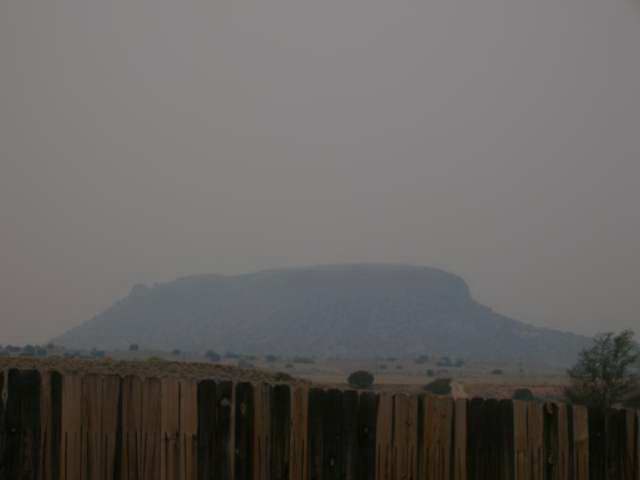
Topography is everything here. Running parallel to the road north of Pojoaque is a geologic formation, a monocline, that’s barely visible from the road and carries a name as obscure as the many others used on maps that have been puzzling people trying to learn where the fire it.

Unnamed and unseen by most, it’s still enough to channel the weather, to keep rain away from the dry area to the east. For a storm indeed was passing through.

Around 4:40 I began to feel a few sprinkles, could see lightening to the west of the Black Mesa. Then the winds resumed and I could smell the smoke. Within twenty minutes the sounds of thunder had moved north, there was only water pocked sand in the drive.


By 6:15 the smoke was creeping out of Los Alamos, a heavy brown presence. Beneath, the grass turned dark gold. To the north, the sun turned red. The air was still.


The smoke continued to move to form an arch over my head that would turn into a skull cap when the light faded.

The sun sank behind the Jemez turning the sky red with its own reflection, more brilliant than the fire.

Then darkness. South towards Los Alamos there seemed to a narrow white line. It seemed to pulse like the northern lights, but that could have been an affect created by smoke distorting my view.

I could no longer tell mirages from reflections from reality.

Top picture: Sun setting in the Jemez, June 27 about 8:15pm.

Middle picture: Smoke to the east, June 27 about 6:55pm.

Bottom picture: The grass to the east under the cap of smoke, June 27 about 7:48pm.

Wednesday, June 29, 2011

The Clarity of Fire


Sunday, June 26, I walked southwest into an arroyo between my house and the Black Mesa. The heat had built up so much in the past week, when the thermometer read 93 at 6pm, that the heat from the clay and sand soil burned through my shoes. For the first time it was uncomfortable to walk on what had become shallow dunes.

I also walked a quarter mile down the road to the northeast where the Pacheco Canyon fire was visible. There’s a break in the ridges of clay and gravel, and it looks like a flood might once have broken through. The area where I was standing is a flat, grassy prickly pear cactus field that edges another arroyo.

It was a normal fire morning.

The winds increased about noon. A few weeks ago I bought a portable wind gauge to learn exactly how severe they were when the locust and tamarix began to twist. Whatever it was designed for, it doesn’t work in New Mexico. I have no idea how severe they were, only that they’ve been much worse this month.

Around two I took a nap. When I awoke, the light coming through the east window of my bedroom had changed. The grass, usually brown, was silver.


I grabbed my camera to try to photograph the effects of light. When I couldn’t see enough grass from my back porch, I started to walk around the house.

That’s when I saw the huge mushroom cloud behind the Black Mesa. It looked like everyone’s worst fears of what could come from Los Alamos.

The New Mexico fire website, nmfireinfo.wordpress.com, said a fire had broken out behind the lab in the Bandelier National Forest. It didn’t have to tell me it was the most powerful fire we’ve seen - and in the 20 years I’ve lived here, they have been three large fires around Bandelier: the Dome Fire of 1996, the Cerro Grande fire of 2000, and this one. There was also one, the La Mesa, in 1977.

I talked to someone yesterday who lives in Los Alamos. He said he when we went into the local hardware store Sunday he saw the first wisps of smoke. When he came out, about 15 minutes later, the fire had grown huge.

At the time officials said the fire was 3,000 acres. When I went to bed they said 6,000 to 9,000 acres. It took the Pacheco Canyon fire a week to reach that size.

When I looked the next morning, they said it was 43,000 acres, much of it to the south and east of the hot spots near Las Conchas. It had taken the Cerro Grande fire two weeks to cover that much land.

One difference was weather. The Cerro Grande fire resulted from a controlled burn begun on May 4, in the spring of a relatively normal year, when the winds are high. This is early summer in the year of a severe drought when high winds have persisted longer than usual.

The other difference was that this fire was more visible than the Cerro Grande. The plume grew, fading to grey in the east where it mixed with whatever smoke was rising from Pacheco Canyon. To the west the edge was gilded by the sun. To the north, the sky was still clear.

When the sun went down, spots of orange became visible. They sometimes merged into a line, sometimes disappeared. Eventually the red warning lights around Los Alamos appeared below and in front of the ridge line of fire.

From where I stood on my back porch I didn’t know if I was actually seeing the fire, or just its reflection in the clouds.


On the one hand there was a sense of great clarity. For much of the day, the smoke had some form. In the night, it was reduced to a thin line of orange. Everything was visible, even if it was only effects of light and smoke I was seeing.

On the other hand there was a feeling no one yet knows what’s going on - that clarity will come in the morning after they’ve made their reconnaissance flights. Then the freefall will be stabilized.

But for now, any human in the area knew there was a fire and had a fairly good idea where it was. The rest was mystery.

Top picture: Las Conchas fire over the Black Mesa, June 26, around 4:46pm.

Middle picture: View to the east, June 26, around 4:43pm.

Bottom picture: Las Conchas fire through the lilacs, June 26, around 8:09pm.

The Invisible Made Visible; the Visible Made Invisible


Two weeks ago, on June 18, I was driving from Albuquerque when I saw smoke to the west. I was somewhere in the flat lands of San Felipe and San Domingo where the road is moving to the northeast to rise to Santa Fe.

Just before the bypass exit for Santa Fe the state had posted a sign warning visibility was poor between Raton and the Colorado border. The fire changed from side to side, was sometimes straight ahead as the road changed directions. Without a compass, one is never quite sure where one is pointed in this mountainous land.

Then as I was headed north the fire stayed to the east, until I passed it coming down the Tesuque hill into the valleys below Santa Fe.

When I got home, I checked the local forest service website, nmfireinfo.wordpress.com, and learned there had been a fire burning for some time near Raton, and that there was a new one in Pacheco Canyon northeast of Santa Fe.

The land there is rugged with few homes to protect. The fire continued to burn, but had little impact on our lives. I could always see the smoke when I was in some high place in Española and every day I could see it from the city limits to Pojoaque where it disappeared behind the ridges.

Sometimes I could see smoke, greyish white and diffuse, from my back porch.

It settled into something like the local tame erupting volcano, sometimes active, sometimes not. There but no menace. Only regretted for destroying recreation lands familiar to people I work with in Santa Fe.

Instead of obscuring the land, the smoke made it more visible. Unless it’s foggy, I see the landscape as three colors. Near are the uplifts of sand, clay and rock along the river. Behind them, nearly the same color, are harder rock. Behind them are the Jemez to the west and the Sangre de Cristo to the east, usually dark shadowy forms.


When the smoke drifted up from the Wallow fire in Arizona, it hid the mountains, then the ridges, then the bad lands. Everywhere people commented on losing the mountains, and would take pictures of what wasn’t there.

This fire was nearer. In the mornings I could see the smoke drifting through the valleys. Because the intervening ridges were different distances from the center of the fire, the density of the smoke varied. The detail that was normally hidden was revealed.

Top picture: The Pacheco Canyon fire, June 26 about 9:35am; taken a quarter mile from my house.

Middle picture: The Black Mesa, June 6 about 7:48pm; usually one can see the mountains behind Los Alamos, the ridges in front and the badlands. Visibility is down to about 2 miles.

The Year the Sun Turned Red


I’ve begun to see clouds differently.

In early June we started to get smoke from the fires in Arizona and, they said, Mexico.

At first it simply got hazy and the sun turned red. When we had dust storms when I lived in Abilene, Texas, the sun turned silver as the sky turned dark at noon.

I don’t know why the difference but suspect it’s in the particles in the air that are filtering the sun - that the dust storm is simply dirt, and all that’s picked up from the ground, while the smoke includes organic matter from burning trees as well as the chemicals used to fight the fire.

That’s when I began to question clouds. For they showed up every evening at about the same time.

I knew that no matter how regular the work of the fire fighters, we couldn’t be exactly the number of miles away from the fire that their smoke got to us at the right time to turn the sun red. I knew the fires were burning 24 hours a day, no matter how many hours the fire fighters were working.

I decided, based on no information, that the smoke was coming our way all day, but that it only became visible when the sun went down. This wasn’t just the disappearance of light, but a function of the sun itself.

During the day, its heat evaporated whatever moisture was in the smoke from the water used to fight it. When the water disappeared, the dust became lighter and fell to the earth. One day I came home to find an orange poppy petal splotched with white spots like someone had spilled bleach on it.

As the sun began dropping in the west, its heat intensity changed and more water remained in the smoke so it became visible.


The fire in Los Alamos began Sunday afternoon. The sunset was normal. Monday was the first day since Arizona filled the sky that the sun was red. The firefighters had begun work in earnest.


Top picture: Smoke from the Wallow fire in Arizona, looking west towards the Jemez, June 2 about 6:57 pm.

Middle picture: The first day of the Las Conchas fire near Los Alamos, before the firefighting began in earnest, June 26 about 8:14pm.

Bottom picture: Smoke from the Las Conchas fire near Los Alamos, looking at the Jemez a little more to the south, June 27 about 7:08pm.

Sunday, March 13, 2011

Cat of the Century

Murder is a crime against society, or so W. H. Auden believed.

In his much reprinted 1948 essay, “The Guilty Vicarage,” he divided crimes into those against individuals, those against society, and those against God. He then argued the mystery story was an attempt to return society to the state of innocence that existed before crime disrupted the social order.

So, what happens to the detective novel when the author doesn’t believe in the legitimacy of society, only accepts the hegemony of the individual?

You get Rita Mae Brown’s Cat of the Century.

Brown began writing mysteries after Lilian Jackson Braun had published The Cat Who Could Read Backwards in 1966 in which a pair a Siamese cats brought a journalist’s attention to oddities that led him to solve a mystery. This 2010 book features Mary Minor Haristeen, known as Harry; her dog, Tee Tucker, and two cats, Mrs. Murphy and Pewter.

Brown’s novel begins like a classic detective story with conflicts within a small group, in this case the board of the alumnae association of what had been a woman’s college in Missouri, a finishing school that had grown into a university. Two women on the board, Mariah and Flo, have been feuding since they were students. Their bickering has forced the retired chairman, Inez, to return to replace a woman, Liz, who couldn’t control the board meetings.

Flo makes clear Mariah is selling fakes in her high-end jewelry store and Mariah accuses Flo and Liz of promoting fraudulent investments. Flo is murdered and Mariah disappears.

The dog smells blood in a manure pile. If this were Lassie or Rin Tin Tin, Tucker would have continued to fuss until Mariah’s body was discovered. But there’s a blizzard and this is a description of a narcissistic society in which private knowledge is sufficient. The animals, acting more like a Greek chorus than Koko and Yum Yum, simply comment among themselves and let the humans be.

About page 149, I reached the point where I realized 17 pages had passed since the murder, that nothing was happening and there were another 127 pages to get through. Actually, nearly a hundred passed before anything more important occurred to explain the murders.

A reader of classic writers like Agatha Christie or Rex Stout would be hard pressed to keep reading the sections that seemed little more than an updated Ladies Home Journal filled with product endorsements for Fred Perry, Volvo and Trader Joe’s mixed with descriptions of houses filled with “cinnamon-scented pillar candles” and meals of poached salmon with hollandaise, “endive salad and new potatoes with parsley” or “roast chicken, crisp baby potatoes, and a light salad.”

But this is not a traditional who-done-it. This is one where characters are criticized for believing in a society of laws and where people never outgrow the values of a status conscious college, where civility is prized and a lady never speaks honestly to anyone but her trusted friends.

If one looks at the book as unraveling a crime against the individual, rather than society, it makes more sense.

To conform to Auden’s views of mysteries, this type of narrative needs to describe the bubble that envelopes the lead character, then show escalating threats against it, until the source of danger is removed and life in the bubble restored to its former tranquility.

All the words spent describing the houses and meals, the shopping trips and clothes build the details of a world we want to join, don’t wish to see destroyed. We learn to care about the people who inhabit that world, Harry; her husband’s first partner, Inez; Inez’s best friend, Tally; and, of course, their pets. After all, they are the victims, not Flo.

The real drama isn’t the murder, but the disintegration of a store keeper, Terri Kincaid. In the opening chapters, she makes Harry actually pay for a pot her dog broke. We’re told Harry always considered her to be “a pain in the neck,” “one of those benighted souls who believed laws were the answer,” and a “smarmy little social climber.”

The bickering among the women on the alumnae board is dangerous, not because it leads to murder, but because it disrupts the world of another member of the protected society by making 98-year-old Inez feel too old to handle difficult people. It also threatens to upstage a celebration honoring Tally.

The murder of Flo becomes something the small group can pass time discussing when they meet in one another’s homes in Virginia. The harassing email messages signed by the dead Mariah are less serious threats to their world than the weather, a blizzard in Missouri, sleet in Virginia.

All these seemingly trivial details that destroy the momentum of the traditional mystery story actually contribute to the feeling of a good world that exists outside society besieged by danger from contact with that society.

Kerri turns out to be a link in a chain of drug dealers who has become an addict herself. Harry realizes the situation when she returns to the store and Kerri throws a china figurine at her. She doesn’t tell her police friend, but instead repeats a private solution: it’s “best to steer clear of those people, especially if they won’t go for help.”

The master drug dealer is revealed to be Liz, who murdered both Mariah and Kerri because they threatened to expose her. None of this is figured out by the principals, but is information passed on by their policewoman friend after Liz attacks Inez and Tally to keep them quiet.

The only comment we get from Harry is that Liz was another “social climber” filled with “tawdry ambition.” Earlier another character had told Flo, Liz “suffers from attention-deficit syndrome,” meaning she always has to be the center of attention. Her crime wasn’t bilking investors or selling drugs, but not being sufficiently acclimated to Harry’s social world.

This novel, like most mysteries, has a subplot that’s supposed to serve as a red herring: the death of a heavy drinker whose wife had already left when he was run over twenty years before. In the end, the murderer is prompted to confess. He’s the black, possibly gay, store keeper whose men’s clothing store is next to Kerri’s.

Throughout Garvey is shown to be everything Liz and Kerri are not, a proper retailer who flatters his customers to make his sales, not one who presumes equality. Since he’s moved into the protected society by knowing his proper place, he’s forgiven for his youthful indiscretion, leaving the scene of an accident, and asked to serve a token number of hours of community service as punishment.

In a mystery whose purpose is to protect a good society from the chaos of the outer world, the list of likely motives changes. In the beginning, when the book still resembles a classic detective novel, Flo thinks the reason people fight is sex or money, then giggles at the thought of sex among the members of the alumnae board.

After Mariah’s disappearance, when attention is still focused on her attempt at embezzling money from the alumnae society, Liz suggests the reason is taxes. What begins as the comment of a single character is repeated in so many contexts that the view no longer differentiates individuals, but begins to characterize the authorial presence. After Kerri’s death, Garvey repeats drugs are a “nontaxable milk train.”

In a society that is perceived to be run by politicians driven by ego and financed by drugs, there is no social order, and therefore no role for logic. After their local policewoman friend explains Liz’s financial shenanigans, Harry admits “I would never have figured it out” while Inez and Tally repeat what they learned in college, “Trust your instincts and don’t expect life to be logical.”

We never learn anything more about Flo’s death than we knew when it occurred. Such details are immaterial to the core story, the description of a perfect world, threatened by deranged individuals who are removed, not by society, but by their own actions. People inside the bubble don’t need to figure out who did it, only observe, confident their particular shell of privilege will protect them.

After the outside threats are removed, we know the world has been restored to Auden’s innocence when the 100-year-old Tally says the adventure made her “suddenly felt forty again.”

Their’s is a special world where both natural and manmade laws are suspended. Tally repeatedly says she expects to outlive them all.

Sunday, February 27, 2011

Vidal, Burr, Bachmann

Gore Vidal’s Burr is a very bad book.

Michele Bachmann read it her senior year in college; she graduated in 1978. I was a bit older, working on my dissertation, when I bought a copy in 1973, soon after it came out in paperback.

She says his snotty treatment of the founding fathers was what offended her. I don’t remember exactly what irritated me, except it made me so angry I wanted to throw the book across the room. At the time, my generalization was that it represented a failure of imagination.

I’ve since continued to read his essays, including the most recent that could use a stronger editorial presence. However, I never read another of his serious works of fiction. Myra Breckinridge might be an important novel, but I’ll never know why.

I eventually did relent a little to read the three mysteries he published earlier as Edgar Box. They were readable, but not compelling enough to make me wish he’d continued writing them. As I recall, the failure of imagination in them was limited to the sex scenes. Following the hard-boiled detective tradition, Vidal felt it necessary to have his hero, Peter Sargeant, become involved with woman. However, he could only say, after he got them together, “and then they did it,” sounding much like an adolescent boy describing the wonders of something he didn’t yet know but needs to pretend he did.

Bachmann says her feelings about the book turned her from being a Democrat to a Republican. I don’t believe she’s ever said why she associated Burr with the Democrats, if it was the politics of Vidal which are snobbishly critical of both parties, or if the person who recommend the book to her was a Democrat.

In my case, I turned on the editorial establishment that had promoted the book as “wicked entertainment of a very high order,” a “tour de force,” a “novel of Stendhalian proportions,” to quote only blurbs from the New York Review of Books, the New York Times, and the New Yorker.

I’ve rarely ever read another review of a novel since, and then only of books or authors I had never heard of, usually from foreign countries. I suspect I’ve missed a good read or two, but I’m know I missed a great deal of boredom from being trapped on the same page with whatever the claque was promoting at the moment.

Sunday, February 20, 2011

Pneumonia

The Affordable Health Care for America Act won’t kill the elderly, as some allege, but misrepresentations about the law and medicine in general absolutely do kill.

Recently a friend of my boss died from pneumonia. He was an uninsured alcoholic who had been sober for 15 years, ate well and spent time in the gym. He delayed going to his doctor until his temperature was rising quickly, then refused to go to the hospital. He apparently believed the antibiotics and his strong body were enough.

In the night his fever increased. His landlady saw him out in the snow, she thinks, trying to bring down his body temperature. She found him dead the following morning. As near as anyone knows, when he lay down he fell asleep and his lungs continued to fill until he couldn’t breathe.

The week before, the mother of a friend died from pneumonia in a nursing home after her father had refused treatment for her. It was bacterial in origin, possibly caused by a piece of food that had become stuck. The woman suffered from dementia and either didn’t notice the irritation or couldn’t explain it. She died less than a day after my friend heard she was sick.

Bacterial pneumonia is treatable with antibiotics. Patients with the viral form usually survive when they’re given intravenous fluids and monitored during the crisis.

As near as the daughter and my boss know, both people weren’t treated because men believed they couldn’t afford the treatment. The eighty-five-year-old woman was covered by Medicare. An emergency room would have had to treat the fifty-something man, regardless of his income or insurance status.

I don’t know if the man was uninsured because, as my boss believes, he was one of the many who have the money, but believe they’re too healthy to need insurance, or if he’d tried in the past and been refused. Perhaps being a recovering alcoholic, for Alcoholics Anonymous says you are never an ex-drinker, is itself a disqualifying pre-existing condition. The new law, with its demand for universal coverage, phases out such hurdles to medical treatment, though it can do nothing about the bitterness created by rejection.

False perceptions arise from the health care debate that emphasizes the high cost of treatment and the plight of the uninsured. We’re constantly told emergency rooms are overwhelmed as a result. The subtexts are that treatment might have become substandard and that people who use them are parasites. We certainly are told the costs are greater.

What people don’t hear is that there are new alternatives to emergency rooms, the urgent care centers. If the man had gone to one, instead of waiting to see his doctor, he would have been diagnosed faster and they probably would have begun treating him immediately because they had the necessary resources on site.

When people hear about the cost of treating the elderly who will never recover all their capacities, they don’t hear there’s a difference between treating a disease like cancer, which may kill anyway, and treating a temporary infection.

The ignorance about the dangers of out of control infections also comes from the same media sources, the ones who deny climate change and evolution. In making their arguments, they treat scientists and science with contempt. That attitude, in turn, reinforces people’s natural fear of disease and distrust of doctors who can’t treat the common cold. It makes some people less likely to listen to the medical programs that do appear on television that try to educate about diseases like pneumonia.

The media would deny its responsibility, in the same way it denied there was any relationship between its words and the actions of Jared Loughner who shot Gabrielle Gifford in Tucson on July 8. They would say they are not responsible for the individual actions of a one-time drunk or a man tired of a marriage. They would say individual actions are just that, individual, and not part of a social pattern.

They might also suggest the solution was eliminating malpractice laws. Regulations and contracts may have dictated what an institution or physician could have done in these situations.
However, I do wonder what ethics can condone a nursing home that doesn’t begin treating a treatable infection immediately or a doctor who doesn’t call the ambulance or send a nurse with a man obviously in need of treatment. I wonder what is their moral obligation to seriously inform people of their choices when they can see the people there are talking to are laboring under serious misunderstandings of medical situations.

Ideas, diffused through an atmosphere of misrepresentations and paranoia that feeds of people’s instinctive fears of the unknown or uncontrollable, indeed can kill as swiftly as the infections they abet.