Showing posts with label 29 Cro-Magnon 1-5. Show all posts

Wednesday, December 30, 2015

Gravettian Life

Will return to Santa Cruz between 1714 and 1732 on Sunday. Now, back to life in early Spain and in areas that preceded the Clovis culture.

Settlements dotted the land between the Danube and the northern foothills from just west of Vienna east to the river’s confluence with the Morava during the Gravettian era.

Bohuslav Klíma originally thought the archaeological site at Pavlov represented one large village with 13 huts. At Dolní Vìstonice he believed five or six huts were used at one time, and that each held 20 to 25 people. The area was enclosed by low walls of mammoth bones.

Since then, carbon dating has shown that there were multiple occupations of the areas, with long periods when bands, and probably mammoths, were elsewhere. Some of the huts served special functions. Four at Pavlov looked like they once were workshops with remnants of stone knapping. Two at Dolní Vìstonice were kilns. Another was open to the sky.

Settlements themselves seem to have served different functions. Many on the south side of the Danube-Baltic watershed may have been winter camps. The recently excavated Dolní Vìstonice VI had a central hearth surrounded by large pits where at least two mammoths were processed. The artifacts found at Pavlov I and Dolní Vìstonice suggest they were centers of communal activities.

If you look carefully at the list of dates below you notice the recurrent stops began around 26,650 years ago and continued to about 25,530 years ago. That was the millennium before the Scandinavian and Alpine glaciers began expanding. One guesses woolly mammoths were already responding to climatic change when they wintered in the Danube valley. There bands using Gravettian technology made the difficult change to become mobile hunters.

In addition to developing shelters in open fields, they were clothed. None of the Moravian burials preserved clothing, only beads, pierced teeth, and shells. From their positions on or near the body, some have been interpreted to be the remains of trim on caps at sites in Russia and Italy. Caps or hoods are one of those things we take for granted that are universal in cold climates.

The burials themselves also showed adaptations to an open environment. A woman in her 40s was found under two shoulder bones from mammoths at Dolní Vìstonice I, while an infant at DV III also was protected by shoulder blades. Three adolescents had been covered with spruce logs and branches at Dolní Vìstonice II.

In each case, the body had been covered with red ochre, and animals remains were left with each. Bones of an arctic fox were found near the left hand of the woman; the right hand still held ten fox canine teeth. The infant had the remains of a necklace of 27 fox teeth. The heads of the two young men were surrounded by pierced canines from arctic foxes and grey wolves, along with ivory beads from mammoth tusks.

Archaeologists assumed the buried individuals had some special status. The woman had signs of a disfigured face. The three adolescents were probably related because they shared rare genetic traits: no frontal sinuses, impacted upper wisdom teeth, and bony spurs in their ears. In addition, the girl laying between the two boys had a shortened, curved thigh, which would have made walking difficult. She also had shortened forearm bones.

As important as their physical attributes were the symbolic grave goods that reflected the same notions as the clay figurines. Next to the woman were some flint flakes and an ivory statue bearing an echo of her facial disfigurement. Most statuettes, like the one found at Willendorf, were generic females with exaggerated breasts, bellies or buttocks.

In addition to clay models, artisans also made images of bears, foxes, and cave lions at Dolní Vìstonice. At Pavlov they created bears and woolly rhinoceroses. Jean Clottes said that of the total 67 statuettes so far identified, 21 were bears, 11 were small carnivores, 9 were felines of some kind, 8 were mammoths, and 4 were rhinoceroses.

Like the statuettes of women mentioned in the last post, most had been fired while they were still wet and shattered. Archaeologists assumes that since they had mastered kiln making and mixed powdered bone with the clay, the fractures were deliberate.

With the exception of foxes, none of the reproduced animals were hunted or used by Gravettians. However, bones of lions and rhinoceros have been found at both Dolní Vìstonice and Pavlov in numbers that suggest they were neither rare nor common. Jirí Svoboda thought some were killed because the attacked the site or tried to raid the supplies. Some of species also would have competed with humans for rights to weakened or young mammoths.

Site Date C14 yrs ago Years Between 20 Year Genera- tions Notes on Timing
DV I 27,790
DV II hearth 27,660 130 6.5
DV II hearth 27,080 580 29
DV II hearth 27,070 10 0.5
DV II hearth 26,970 100 5
DV II hearth 26,920 50 2.5
Pavlov I 26,730 190 9.5
        Gap of 80 years
Pavlov I 26,650 80 4
DV II burial 26,640 10 0.5 5 generations in 100 years
Pavlov I 26,620 20 1
Pavlov I 26,580 40 2
DV II hearth 26,550 30 1.5  
        Gap of 120 years
DV I hearth 26,430 120 6
Pavlov I 26,400 30 1.5 2 generations in 10 years
DV II 26,390 10 0.5
        Gap of 200 years
DV IIa 26,190 200 10
Pavlov I 26,170 20 1 2 generations in 30 years
DV III 26,160 10 0.5
DV II 26,100 60 3
        Gap of 160 years
Pavlov I 26,000 100 5
DV I  25,950 50 2.5 2.5 generations in 50 years
        Gap of 60 years
DV IIa 25,890 60 3  
DV IIa 25,870 20 1 7.5 generations in 150 years
Pavlov I 25,840 30 1.5
DV I middle 25,820 20 1
DV I 25,790 30 1.5
DV II hearth 25,740 50 2.5  
        Gap of 170 years
DV II burial 25,570 170 8.5
Pavlov I 25,530 40 2 2 generations in 40 years
Pavlov I 25,160 370 18.5
Pavlov I 25,020 140 7
DV III hearth 24,560 460 23
DV I 22,840 1720 86

Dates from Don Hitchcock from material provided by Jirí Svoboda
DV = Dolní Vìstonice

Notes:
Clottes, Jean. "Art between 30,000 and 20,000 bp," in Wil Roebroeks, Margherita Mussi, Jiøí Svodoba and Kelly Fennema, Hunters of the Golden Age, 1999; the other animal statues were 6 birds, 6 horses, 1 caprid (ibex), and 1 deer.

Hitchcock, Don. "Dolní Vìstonice and Pavlov Sites," Don’s Maps website.

Jochim, Michael. "The Upper Paleolithic," in Sarunas Milisauskas, European Prehistory, 2011 second edition.

Soffer, O., J. M. Adovasio, and D. C. Hyland. "The ‘Venus’ Figurines: Textiles, Basketry, Gender, and Status in the Upper Paleolithic," Current Anthropology 41:511-537:2000.

_____, _____, _____, B. Klíma, and J. Svoboda. " Perishable Industries from Dolní Vìstonice I: New Insights into the Nature and Origin of the Gravettian," Society for American Archaeology, annual meeting, 1998.

Svoboda, Jirí. "The Pavlov Site, Czech Republic: Lithic Evidence from the Upper Paleolithic," Journal of Field Archaeology 21:69-81:1994.

_____. "The Gravettian on the Middle Danube," Paleo 19:203-220:2007.

_____, V. Formicola, and A. Pontrandolif. "The Upper Paleolithic Triple Burial of Dolní Vìstonice: Pathology and Funerary Behavior," American Journal of Physical Anthropology 115:372-374:2001.

Sunday, December 27, 2015

Gravettian

Will return to Santa Cruz between 1714 and 1732 next Sunday. Now, back to life in early Spain and in areas that preceded the Clovis culture.

The Gravettian arose around 30,000 years ago when the climate supported pine and spruce on lands dominated by steppe vegetation. It lasted until the severe cold of the last glacial maximum which began about 22,000 years ago.

Along the Danube, groups at Willendorf, Dolní Vìstonice and Pavlov depended on mammoths. To their west and in Ukraine, bands relied on reindeer. On the Iberian and Italian peninsulas people ate red and roe deer. North of the Black Sea they hunted bison and horses.

On the map below, the Danube is traced in red. The Willendorf site is about 50 miles west in Austria. Dolní Vìstonice and Pavlov are a few miles apart on the Czech side of the Morava river that flows along the border between the Czech Republic and Slovakia.


Archeologists found a female figure carved from limestone and stained with red ochre at Willendorf in 1908. In 1924, others found clay figurines of women at Dolní Vìstonice. Few had heads, arms or feet. Marianna Gvozdover noted the statuettes found to the east emphasized breasts and bellies. Those found in the south of France exaggerated thighs and hips. The ones from the Danube were less schematic.

The statuettes captured the popular imagination, but archaeologists saved all the clay remnants. Recently, Olga Soffer recognized patterns on some of the pieces that suggested basketry or cordage. They provided more detailed information about how people survived on open sites instead of in the caves and rock shelters used in Iberia.

At Pavlov, Bohuslav Klíma had uncovered a 33' x 20' swallow depression with the remains of burned posts. Inside, the hearth was surrounded by a wall of mammoth bones. Another depression in the area was surrounded by bones. It contained four hearths, with seven nearby. He postulated they had erected frames over the areas and covered them with hides. Soffer’s team found evidence of plant fibers in the dried clay that suggested they had daubed the interiors.

Some of the clay fragments from Dolní Vìstonice suggested plant materials had been plaited into mats. They speculated they could have been used on the floor where their weaves pressed into the clay. When the structure burned, the clay was fired for posterity.

Stoffer’s team also found evidence of cordage. Four pieces from Pavlov and two from Dolní Vìstonice had been knotted. That suggested they were making nets.

The bones found at Dolní Vìstonice came from woolly mammoth, horse, grey wolf, reindeer and arctic hare. At Pavlov there were reindeer, arctic hare, grey wolf, arctic fox and mammoth. Jirí Svoboda suspected there may have been more mammoths at Pavlov, but that erosion on one side of the site may have destroyed them.

Hares and foxes weren’t easy to kill with hand-held stone weapons. Their bones suggested cooperative, if not communal, hunts that allowed groups to come together and still have enough to eat. According to Miriam Nývltová-Fisáková, they also used many different bones from arctic foxes and grey wolves for tools. The ulna in the forelegs of red foxes and arctic hares were used for awls and barbs.

The long, narrow stone blades were part of the Pavlovian regional variant of the Gravettian. Svoboda believed their origins lay in the Levant around 40,000 years ago. Tsenka Tsanova found the technology had reached Kozarnika cave along the lower Danube in present-day Bulgaria between 39,000 and 33,000 years ago. Tool makers used large fragments of long bones to finish the edges.

What was remarkable about the blades wasn’t their form, but their raw material. The stones weren’t local. Svoboda discovered the flint and radiolarite used at Pavlov came from the other side of the watershed between the Baltic and the Danube. At Willendorf, Philip Nigst said they used local chert and brought flint from the far north.

Bands from Pavlov and Dolní Vìstonice no doubt followed mammoth trails, if not mammoths, from their Danube camps up the tributaries of the Morava river to its headwaters in the Carpathian mountains and then through the Moravian Gate to the plains on the other side. Today’s pass is at an altitude of 1,020 feet.

Notes:
Guadelli, Aleta, et alia. "The Retouchers from the Gravettian Levels in Kozarnika Cave," International Conference of Archaeozoology, Worked Bone Research Group, biennial meeting, 2011.

Gvozdover, M. D. "The Typology of Female Figurines of the Kostenki Paleolithic Culture," Soviet Anthropology and Archaeology 27:32-94:1989; cited by Soffer (2000).

Hitchcock, Don. "Dolní Vìstonice and Pavlov Sites," Don’s Maps website.

Jochim, Michael. "The Upper Paleolithic" in Sarunas Milisauskas, European Prehistory, 2011 second edition.

Klíma, Bohuslav. Work discussed by Svoboda (1994).

Musil, Rudolf. "Animal Prey," in Svoboda (2005); cited by Svoboda (2007).

Nigst, Philip R. "Willendorf II: Geography and Culture," in Claire Smith, Encyclopedia of Global Archaeology, 2014.

Nývltová-Fisáková, M. "Animal Bones Selected for Tools and Decorations" in Svoboda (2005).

Soffer, O., J. M. Adovasio, and D. C. Hyland. "The ‘Venus’ Figurines: Textiles, Basketry, Gender, and Status in the Upper Paleolithic," Current Anthropology 41:511-537:2000.

_____, _____, _____, B. Klíma, and J. Svoboda. " Perishable Industries from Dolní Vìstonice I: New Insights into the Nature and Origin of the Gravettian," Society for American Archaeology, annual meeting, 1998.

_____, _____, and B. Klíma. "Upper Palaeolithic Fibre Technology: Interlaced Woven Finds from Pavlov I, Czech Republic, c. 26,000 Years Ago," Antiquity 70:526-534:1996.

Svoboda, Jirí. "The Pavlov Site, Czech Republic: Lithic Evidence from the Upper Paleolithic," Journal of Field Archaeology 21:69-81:1994.

_____. "Gravettian Mammoth Bone Deposits in Moravia," The World of Elephants International Congress, 2001; cited by Hitchcock.

_____. Pavlov I - Southeast. A Window into the Gravettian Lifestyles, 2005.

_____. "The Gravettian on the Middle Danube," Paleo 19:203-220:2007; included comments on origins in Levant and Bulgaria.

Tsanova T. Les Débuts du Paléolithique Supérieur dans l’st des Balkans, 2006; cited by Svoboda (2007).

Graphics: Geologik, "Flow of the Danube River," uploaded to Wikimedia Commons, 12 February 2007, based on map from United States, Central Intelligence Agency, World Factbook.

Sunday, December 06, 2015

Cro-Magnon Cold Period Cultures

Will return to Santa Cruz between 1714 and 1732 in a few weeks. Now, back to life in early Spain.

While the Aurignacian was diffusing to the west in the Indian-summer of the warm period, the onset of the new colder era in the east drove mammoths out of central Asia about 38,000 years ago. Those who depended on them may have followed. The merger of two cultures along the upper Danube river led to the development of the Gravettian. These were the first people to experiment with hardening clay with fire. They also left evidence of bone needles, basketry and cordage, perhaps for snares.

Their technology was slow to penetrate the west. Still 59 Gravettian sites have been located on the Iberian peninsula.

It disappeared about 22,000 years ago. The climate had continued to deteriorate with the expansion of the glaciers around 25,000 years ago. Much of northern and central Europe became uninhabitable arctic desert. Animals and plants retreated to refuges of the Pyrenees and Cantabrian mountains, where the Solutrean appeared about 20,000 years ago and disappeared about 5,000 years later. They were the first Europeans to throw their spears.

People living along the Danube moved east onto the Russian plains, where their Gravettian tools evolved into Epigravettian. The map below shows the Solutrean in rust and the late Gravettian in plum.  White represents glaciated areas.


Still farther east, in the mountainous region beyond Lake Baikal, Cro-Magnon culture became more complex, sometime after 30,000 years ago. Evgeny Rybin said, the reasons for the divergent life style in the open steppe were not yet identified, but could include "interactions between migrating human communities, ecological, and/or demographic stress."

Another merger of hitherto independent groups occurred in southern France where people were crowed together in refuges. Again, a new technical culture developed, this time around 16,000 years ago when the climate began warming. During the Magdalenian era, large central sites developed around mountain caves that functioned as civilization centers. Groups came together for ceremonies, but lived in smaller camps.

The map below shows the extent of the Magdalenian.


While tools changed through time, regional variations that arose from the local fauna persisted. Western areas of Europe relied on reindeer and tended to frequent caves, while eastern parts exploited mammoths in open-air sites. In northern Spain, individuals continued to eat horse and red deer.

Leslie Freeman said, during the unstable but generally warm Aurignacian of MIS3, 13 species were reported from 15 Cantabrian occupation layers with sites averaging 4.5 animals. Horse and red deer were the most common.

The number of species rose in the Solutrean as animals migrated south during the cold MIS2 years. He counted 19 species, with 8 occupation layers averaging 7.3. Horses were the most common. He believed the Pleistocene species of Equus tended to be associated with the open vegetation of colder climates.

During the severe conditions of the early Magdalenian, the number of species dropped to 9. Many of the 14 occupation sites only had 3. In the later Magdalenian, as the climate began to warm again, the variety rose to 22, and the average to 5.4 in 11 sites. Red deer was the most common. Cervus elaphus prefer woodlands that thrive in slightly warmer environments.

Notes:
Freeman, L. G. "The Significance of Mammalian Faunas from Paleolithic Occupations in Cantabrian Spain," American Antiquity 38:3-44:1973. He was counting occupation layers; any archaeological site can have more than one occupation. He was only including those that had identifiable animal remains.

Jochim, Michael. "The Upper Paleolithic," in Sarunas Milisauskas, European Prehistory, 2011 second edition.

Rybin, Evgeny P. "Middle and Upper Paleolithic Interactions and the Emergence of ‘Modern Behavior’ in Southern Siberia and Mongolia" in Yousuke Kaifu, et alia, Emergence and Diversity of Modern Human Behavior in Paleolithic Asia, 2015.

Graphics:
1. Wobble. "Map of Europe 20,000 years Ago," uploaded to Wikimedia Commons, 25 February 2007.

2. Sémhur. "Location Map of Homo Sapiens during Magdalenian Culture, between 19,000 - 12,000 BP," uploaded to Wikimedia Commons, 6 February 2010.

Sunday, November 29, 2015

Cro-Magnon Warm Period Cultures

Will return to Santa Cruz between 1714 and 1732 in a few weeks. Now, back to life in early Spain.

The Würm glacier went through three phases: a cold one from 71,000 to 60,000 years ago (marine isotope stage 4), a warm one from 60,000 to 25,000 (MIS 3), and another cold period from 25,000 to 12,000 (MIS 2).

During the warm period, sea levels were still at least 200' (60 meters) below current levels, and often 300' (90 meters) because ice sheets trapped so much of the available water. In the second cold period, around 21,000 years ago, waters were 410' (125 meters) lower than today.

Within the middle phase, decade-long periods of relative warmth and chill alternated. They fell into four longer-term warm eras which ended when glaciers calved, sending cold water into the oceans and lowering temperatures. The warm times, when the Greenland ice contained higher concentrations of the oxygen18 isotope, peaked 58,000, 53,000, 47,000, and 39,000 years ago.

Cro-Magnon tools show humans reacted to these changes in their environments. No one will hazard exact chronologies because the effects of the climate varied by location, and human responses often were modulated by other factors.

The first phase occurred at least 90,000 years ago in the warm period between the Riss and Würm glaciers. Homo sapiens left remains at Qafzeh and Skh l in the Levant with technology no different than that of the Neanderthals. There’s no evidence they moved farther.

Another group began moving as the climate warmed some during the Würm glacier about 60,000 years ago. Jean-Jacques Hublin said, they moved north into central Europe, arrived at Bohunice in Moravia about 48,000 years ago. They traveled east into central Asia where they reached the Altai mountains around 47,000 years ago. According to Ted Goebel they used a flat-faced technology.

When they encountered the colder conditions of the Danube, Jirí Svoboda said, they developed a new technology, the Aurignacian. The most important trait defining their toolkit was that, instead of a few general purpose tools, men made some for specific purposes. They also began working with bone and antler. They learned to split it as they had earlier mastered splitting rock.

From there, Aurignacian tools moved west, tracking south of the cold front. They appeared in the Bacho Kiro cave in Bulgaria 37,900 years ago, France 37,800 years ago and northern Spain about 30,000 years ago. The tools didn’t penetrate southern Spain until 27,500 years ago.

The technology also moved back south toward the Zagros mountains along the modern boundary between Iran and Iraq. Yafteh cave was occupied between 30,000 and 35,000 years ago.

The technology had disappeared by 27,000 years ago. The map below shows the distribution of important sides in Europe.


In the east, Goebel said the migrants moved from the Zagros mountains across the uplands of central Asia to the Altai mountains in southwestern Siberia. Next they moved across Siberia past Lake Baikal through the Trans-Baikal mountains 42,000 years ago. From there they passed into Mongolia sometime between 41,000 and 43,000 years ago. Some moved south into northern China about 30,000 years ago where the encountered other people who had moved through southeast Asia.

They made an independent adaptation to the cold that used bone, antler and ivory for points, awls, and needles. They made fewer personal ornaments than the Aurignacians, and less evidence of ochre has been found.

Notes:
Goebel, Ted. "The Overland Dispersal of Modern Humans to Eastern Asia," in Kaifu. He has a good map showing the location of archaeological sites that mark the move east.

Hublin, Jean-Jacques. "The Modern Human Colonization of Western Eurasia: When and Where?", Quaternary Science Reviews 118:194-210:2015. He has a good chart showing phases of the Aurignacian with a time line showing coinciding changes in levels of oxygen18 isotopes in Greenland ice cores.

Kaifu, Yousuke, et alia. Emergence and Diversity of Modern Human Behavior in Paleolithic Asia, 2015.

Siddall, M., E. J. Rohling, W. G. Thompson, and C. Waelbroeck. "Marine Isotope Stage 3 Sea Level Fluctuations: Data Synthesis and New Outlook," Reviews of Geophysics, December 2008. The warm periods were Dansgaard-Oeschger events, the cool ones were Heinrich events, the four eras were bond cycles.

Svoboda, Jirí. "Early Modern Human Dispersal in Central and Eastern Europe," in Kaifu.

Graphics: Hugh Charles Parker, "Aurignacian Culture Map," uploaded to Wikimedia Commons, 2 June 2011.

Sunday, November 22, 2015

Cro-Magnon Population

Cro-Magnon is one of those terms that has no technical meaning, and yet carries very specific connotations to us non-specialists.

Anthropologists would prefer to use "Upper Paleolithic" for late ice-age cultures and "European Early Modern Humans" for the first Homo sapiens to arrive on the continent. If they had their druthers, they wouldn’t even refer to species, just to technologies and their relationship to the great glacial phases, or rather to their marine isotope stages.

Abri de Cro-Magnon was an archeological site in Aquitaine in southwestern France discovered in 1868 that contained remains of four skeletons that clearly weren’t Neanderthal. They probably were deliberately buried at the back of the cave. The bones were stained with red ochre and surrounded by perforated shell and animal tooth ornaments. Tools were made from flint and bone. Stone lined hearths and remains of reindeer and mammoths also were found in the limestone rock shelter.

The site, dated to between 30,000 and 32,000 years ago, was typical of those found later. It may be imprecise to make it an eponym for an era, but it’s much easier to remember than the alternatives.

Modern humans, Homo sapiens sapiens, emerged about 200,000 years ago as the Riss glacier was forming.

No species is static. Genetic mutations occur in every generation. In time, accumulations of significant changes are enough to form distinctive subgroups biologists call haplogroups.

DNA studies of the Y chromosome tell us Native Americans belong to the Q group and modern Europeans to the R. They also confirm the ancestor of both was L3, who evolved in Africa.

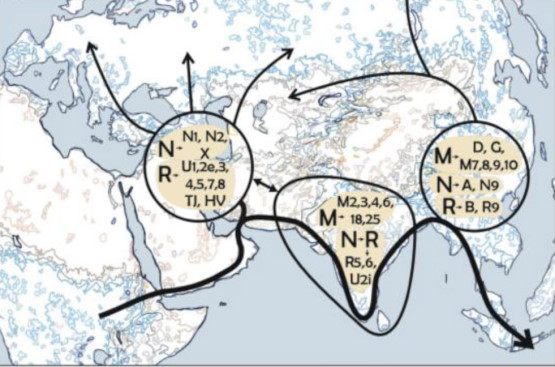
After L3 moved onto the Arabian peninsula, haplogroup N coalesced about 71,000 years ago. The expansion into Europe occurred about 50,000 years ago, or about 20,000 years before the Cro-Magnon burial.


The N population also diffused east. Haplogroup Q developed in northern Asia somewhere between 22,000 and 17,000 years ago, during the last glacial maximum of the Würm period from the M haplogroup via the intermediate P grouping. The M group is thought to have emerged 60,000 years ago, the P between 27,000-45,000 years ago.

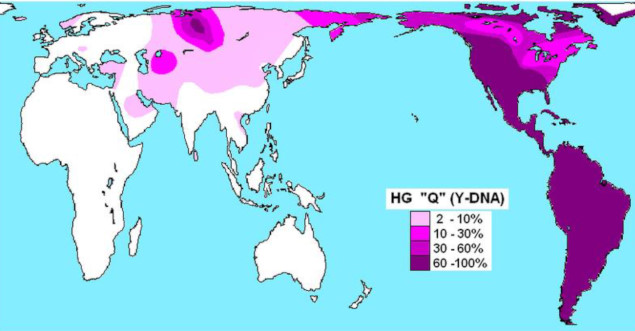
Maulucioni’s reconstruction of the diffusion of Q shows most Native Americans, including local Tewa speakers are part of that stream. A team lead by Morten Rasmussen established the DNA of an infant buried in Montana around 10,000 years ago (8000 bc) was part of the dark purple on the map below.


Maulucioni also shows the areas where the Q marker on the Y chromosome has been diluted by other groups. The rosy purple corresponds roughly with the later influx of Athabascan and Algonquin speakers. Navajo and Apache are part of the first linguistic group, now called Na-Dené.

The medium purple represents the Inuit and Eskimoes.

More than 40,000 years may have passed between the time the first Homo sapiens moved into Europe and some migrated across the Bering Strait into North America. If it took women twenty years to reproduce, that was 2,000 generations of genetic change and cultural continuity.

Anthropologist working with Jean-Pierre Bocquet-Appel have tried to estimate the number of N-type individuals living in Europe using the known characteristics of food animals. They classified modern hunting groups by their prey and climate.

Next they used the modern groups’ demographic profiles as indicators of numbers of hungry beings each biome could support. That is, they recognized the diet of reindeer in Lappland today differs from that of reindeer in paleolithic Aquitaine.

From what was known about each site and the climate at the time, they then estimated populations for each. From there, they calculated the Cro-magnon total from number of sites.

They believed from the first entry of modern Homo sapiens to the last cold peak in the Würm glacial, the number averaged 4,400 to 5,900 inhabitants. Some 16,500 years ago, the climate began slowly warming and the population expanded to 28,800 inhabitants.

By way of comparison, San Juan pueblo counted 6,748 in the 2010 census. The combined total for our local zip codes that year was about 24,200 spread from Santa Clara to Valverde over 190 square miles.

Notes:
Advameg, Inc. Zip code data on City-Data website, run by Lech Mazur. The local zip codes are: Española and Santa Clara (87532), Santa Cruz (87533), Alcalde to Leyden (87511), and Chamita, San Juan and Velarde (87566).

Bocquet-Appel, Jean-Pierre, Pierre-Yves Demars, Lorette Noiret, and Dmitry Dobrowsky. "Estimates of Upper Palaeolithic Meta-Population Size in Europe from Archaeological Data," Journal of Archaeological Science 32:1656-1668:2005.

Rasmussen, M., et alia. "The Genome of a Late Pleistocene Human from a Clovis Burial Site in Western Montana," Nature 506:225-229:2014.

Stringer, Christopher B. and Alison S. Brooks. "Cro-Magnon," in Eric Delson, Ian Tattersall, John Van Couvering, and Alison S. Brooks, Encyclopedia of Human Evolution and Prehistory, 2004 edition.

Wikipedia entries on various haplogroups.

Maps:
1. Metspalu, M., et alia. "Suggested Migratory Route of the ‘Out of Africa’ Migration According to Mitochondrial DNA," BioMed Central Genetics 5:26:2004.

2. Maulucioni. "Haplogroup Q (Y-DNA) Distribution," Wikimedia Commons, 16 July 2010.